Crypto Spot Trading: Pairs, Order Books and Your First Trade Checklist
Spot trading means buying or selling an asset for settlement under the venue's rules, rather than simply taking exposure through a derivative. In this guide, unleveraged spot means using funds you already have..
Educational guide. Examples are hypothetical, not live quotes. Not personalized investment advice.
Spot trading means buying or selling an asset for settlement under the venue's rules, rather than simply taking exposure through a derivative. In this guide, unleveraged spot means using funds you already have. Buying BTC on an exchange may give you an account balance representing a claim on the platform; withdrawing it to your own wallet is a separate custody decision.
Read a trading pair correctly
In BTC/USD, BTC is the base asset and USD is the quote asset. A price of $50,000 means one BTC costs $50,000. A $250 purchase would buy 0.005 BTC before costs at that price. These figures are illustrations, not current quotes. BTC/USDT uses a stablecoin as the quote asset, not a bank dollar balance; stablecoins add issuer, depeg and network risks.
The order book lists resting bids and asks. The highest bid is the best displayed buy price; the lowest ask is the best displayed sell price. The gap is the spread. The last traded price is historical information—not a promise about the price available for your next order.
Why a quote and a fill can differ
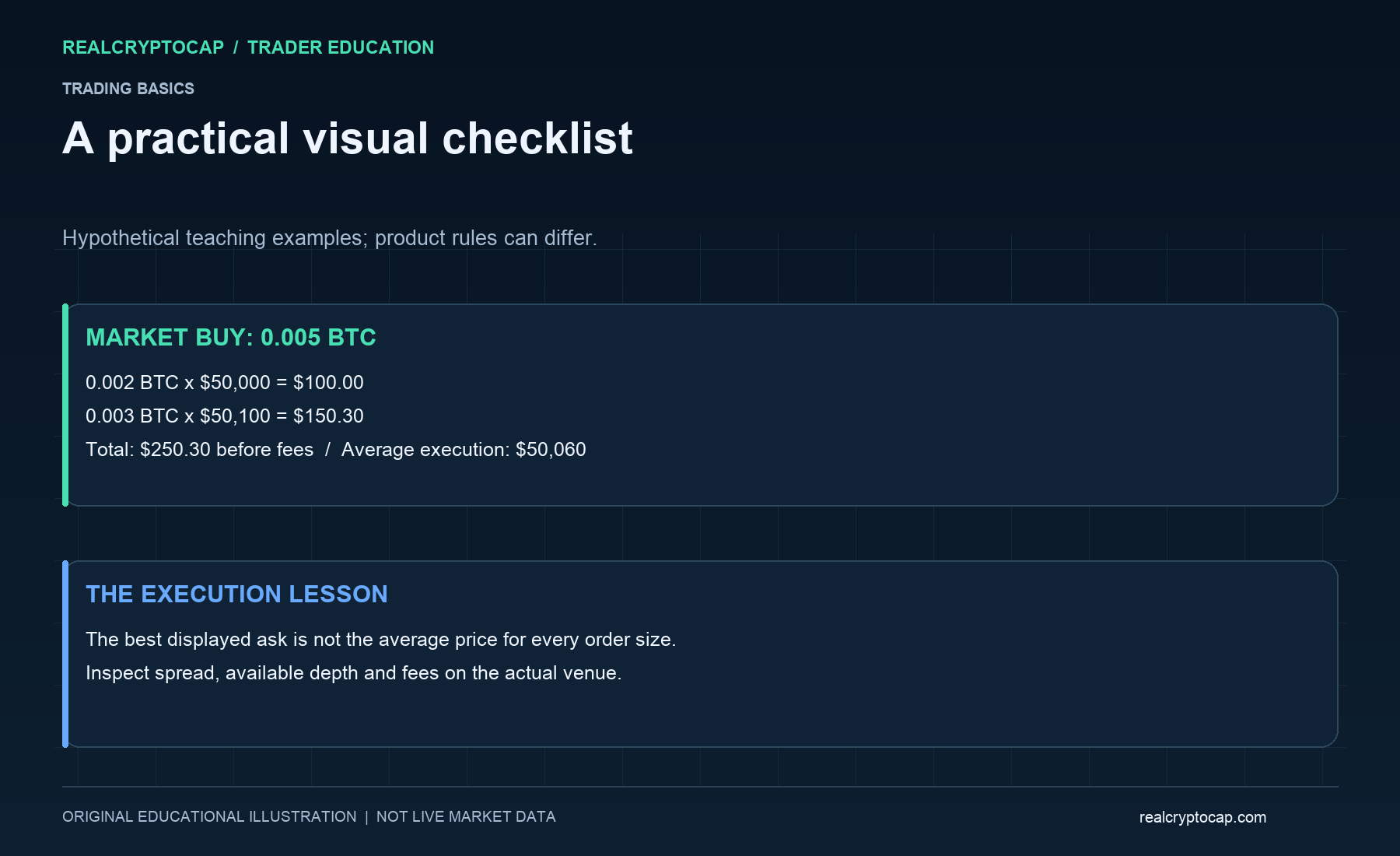
Suppose the asks offer 0.002 BTC at $50,000 and 0.003 BTC at $50,100. A market buy for 0.005 BTC would cost $250.30 before fees if those offers remain available: $100 plus $150.30. Its average execution price is $50,060, not $50,000. Real order books can change while an order is being processed.
This is why liquidity matters alongside volume. A market can report large daily activity yet offer little depth near the current price when you need to trade. Large orders can consume multiple price levels. A headline price or market-cap rank on a tracker does not show the executable depth on your chosen venue.
A step-by-step pre-trade checklist
1. Confirm the venue is available and lawful in your jurisdiction. Review its custody arrangement, trading fees and withdrawal rules. Enable strong account security using supported methods, preferably phishing-resistant authentication where available.
2. Verify the exact pair, ticker and asset identity. Similar symbols and wrapped versions can describe different instruments. Distinguish your available balance from funds reserved in open orders.
3. Check the spread and depth for the intended order size. Compare the total expected cost, including fees. A simple-buy quote and an advanced order-book interface may have different cost structures.
4. Choose an order type deliberately. A market order prioritizes execution at available prices; a limit order specifies your worst acceptable execution price but might never fill. Read next: https://realcryptocap.com/articles/crypto-limit-orders-explained.
5. Review units before submission. Some interfaces ask for base quantity, others for quote-currency spend. Check whether the estimate includes fees and whether an order can partially fill.
6. After execution, inspect the actual fills, average price, fees and remaining open quantity. Save records for your trading journal and applicable tax reporting. Do not assume the estimated preview is the final receipt.
Spot is simpler, not safe
A fully paid, unleveraged spot position does not ordinarily face a margin liquidation caused solely by a falling price. It can still lose most or all of its value. Delistings, thin liquidity, platform failure and withdrawal suspensions can make exiting difficult. Holding a token in self-custody removes some exchange exposure but adds key-management and transaction risks.
Before deciding whether to withdraw, read https://realcryptocap.com/articles/wallets-hot-cold-web-wallets. Never transfer on a network the recipient does not support. Withdrawals can involve minimum amounts, network fees and memo requirements.
Use market data as context
RealCryptoCap's https://realcryptocap.com/market-data can help you explore the broader market before focusing on a pair. Check the actual venue's order book and fee schedule before placing any trade. This guide explains mechanics, not which coin to buy or when to buy it.
Sources and further reading: Coinbase, How to trade with limit, market, stop-limit, and bracket orders — https://www.coinbase.com/learn/advanced-trading/order-types; Kraken, What is crypto margin trading? — https://www.kraken.com/learn/what-is-crypto-margin-trading. Independent educational synthesis; no endorsement implied.