Crypto Paper Trading: Practice a Process, Not a Fantasy Profit Curve
Paper trading applies trading rules to current market conditions without risking real trading capital. It is forward testing: you make decisions as events unfold, unlike backtesting, where the data already exists..
Educational guide. Examples are hypothetical, not live quotes. Not personalized investment advice.
Paper trading applies trading rules to current market conditions without risking real trading capital. It is forward testing: you make decisions as events unfold, unlike backtesting, where the data already exists. A simulator can test discipline and workflow, but its fills and emotional stakes are not the same as live trading.
Define one experiment
Choose a single instrument, venue reference, timeframe and set of rules. An entry such as buy when the chart looks strong cannot be evaluated consistently. Instead, define the exact signal, the information required, the earliest possible execution time, the exit rule and what would invalidate the experiment. An explicit rule can still be unprofitable; precision simply makes it testable.
Use a realistic virtual account size. A $1 million paper account tells you little about the minimum trade sizes, fees and concentration constraints affecting a much smaller account. Do not reset the balance after losses and report only the successful attempt.
Build a journal before the first trade
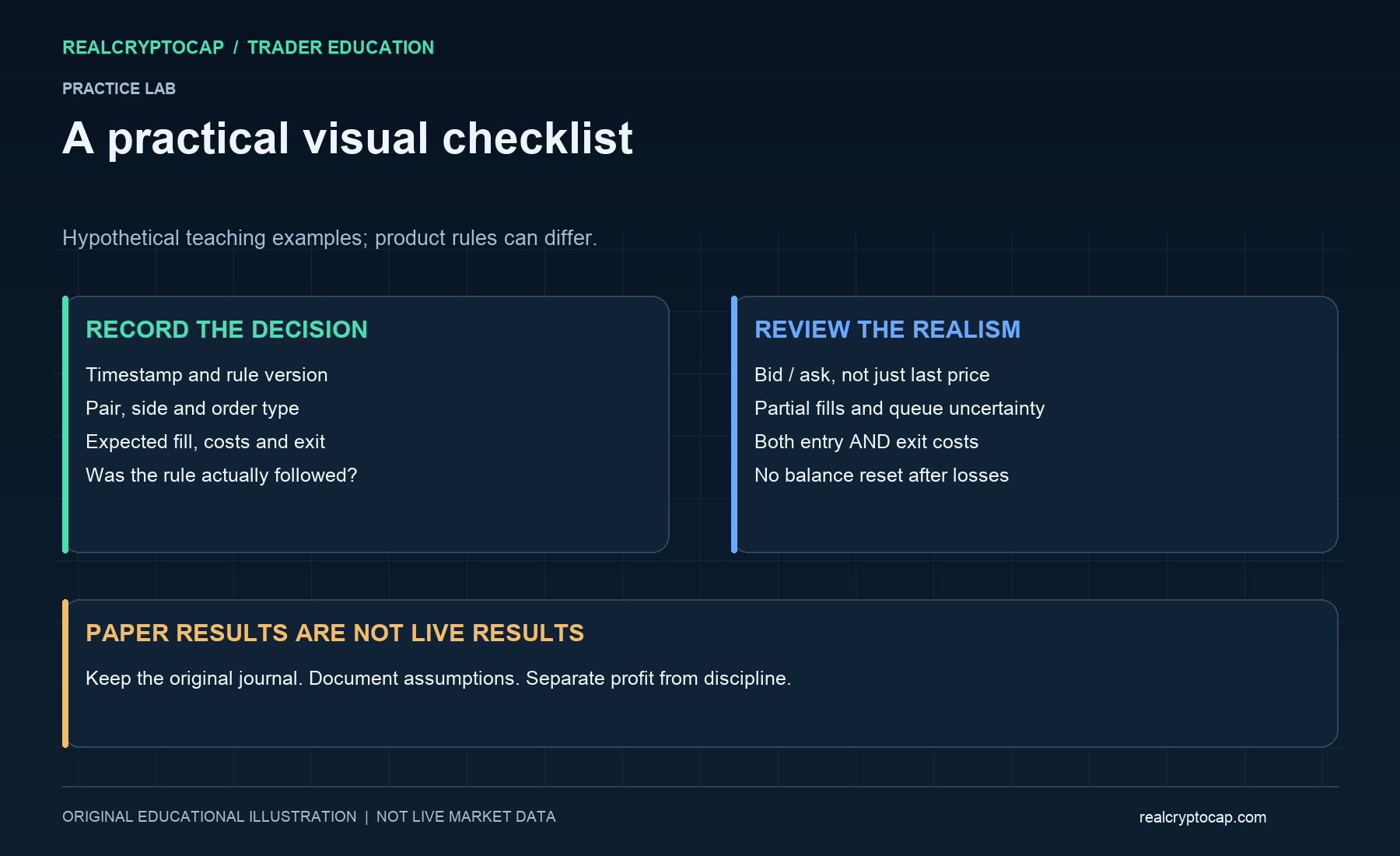
Create columns for decision timestamp, pair, timeframe, rule version, signal, intended order type, requested size, assumed fill, fees, slippage, exit, result and rule compliance. Record skipped signals and cancelled orders as well as completed trades. Keep a screenshot or note of what was visible at the time without including private account information.
Your journal should separate strategy outcomes from execution mistakes. A losing trade that followed the rules is different from a profitable trade entered outside the plan. If you only track money, you may reward behavior that cannot be repeated consistently.
Model fills conservatively
For a simulated market buy, use the ask side and available depth where possible, not the last chart price. For a simulated sell, consider the bid side. Include both entry and exit costs. If only candle data is available, document the approximation rather than presenting it as an exact executable price.
For limit orders, a candle touching the limit is not proof of a fill. Queue position and available quantity matter. Mark uncertain fills separately or use conservative assumptions. If your plan depends on very fast execution, a simple spreadsheet simulation may be inadequate.
A hypothetical journal entry
A learner uses $5,000 of virtual equity and models buying 0.01 BTC at $50,000, then selling at $50,500. Gross profit is $5. With hypothetical 0.10% fees on each side, costs are $0.50 plus $0.505, leaving $3.995 before slippage and other charges. These are assumed rates and prices, not a claim about any exchange's current pricing.
Now change the assumed fills and costs. If a small deterioration erases the apparent edge, that is useful information. A simulator's attractive headline return may depend more on generous fill assumptions than on a repeatable strategy.
Review on a predefined schedule
Choose a review window and a minimum set of observations before starting; there is no magic number of trades that proves an edge. Review net results, drawdown, exposure, turnover, missed signals and rule adherence across differing conditions. A few wins in one quiet week do not establish robustness.
If you change the rules, create a new version and start a separate evaluation. Do not retroactively reinterpret losing signals. Keep the original record so you can distinguish learning from selective reporting.
What paper trading cannot prove
Real losses create pressure that virtual balances do not. Live platforms can reject orders, change margins or go offline. Simulators may omit network delays, borrowing constraints, funding and taxes. Successful paper results do not establish that real trading will be profitable or appropriate for you.
Use the experiment to identify weaknesses, not to justify increasing leverage. Read https://realcryptocap.com/articles/crypto-backtesting-beginners-guide to test historical behavior, then compare the historical assumptions with the forward record.
Sources and further reading: Binance Academy, How to Backtest a Trading Strategy — https://academy.binance.com/en/articles/how-to-backtest-a-trading-strategy; Binance Academy, What Is Backtesting? — https://academy.binance.com/en/articles/what-is-backtesting. Original workflow and hypothetical example; no affiliation implied.