Crypto Margin and Leverage: Understand the Losses Before the Multiplier
Leverage increases exposure relative to the capital supporting a position. It magnifies losses as well as gains. Margin trading can involve borrowing to trade spot assets, while futures and perpetuals are.
Educational guide. Examples are hypothetical, not live quotes. Not personalized investment advice.
Leverage increases exposure relative to the capital supporting a position. It magnifies losses as well as gains. Margin trading can involve borrowing to trade spot assets, while futures and perpetuals are derivatives with different mechanics. They are not interchangeable products merely because their order forms display the same leverage number.
Start with exposure, not the leverage slider
Imagine $1,000 of equity supporting a $5,000 linear long exposure. That is 5x exposure relative to equity. A 2% favorable move produces approximately $100 of gross profit, or 10% of the original $1,000. A 2% adverse move produces approximately $100 of gross loss. Trading costs and the instrument's exact contract design change the final result.
At 10x exposure, the same adverse 2% move corresponds to roughly 20% of starting equity before costs. This arithmetic is not a liquidation-price calculator. Exchanges generally require maintenance margin and can liquidate before equity reaches zero. Fees, mark prices, collateral haircuts and changing collateral values also matter.
Understand the margin terms
Initial margin is the amount required to establish a position. Maintenance margin is the minimum required to keep it open under the venue's rules. Equity typically reflects collateral and unrealized profit or loss, with adjustments specific to the product. A margin call or warning is not a promise of time to react: liquidation can be automated and rapid.
A long position benefits from rising prices; a short benefits from falling prices. A short's risk can grow as the asset rises. Do not assume the amount initially deposited is an absolute maximum loss. Legal obligations, deficit treatment and any negative-balance protection depend on the product and jurisdiction.
Cross margin versus isolated margin
Where supported, isolated margin assigns collateral to a particular position. Cross margin can share eligible collateral across positions, potentially putting a broader balance at risk. Neither setting removes liquidation risk. Features such as auto-add margin can change how much collateral is exposed, so inspect the actual account configuration.
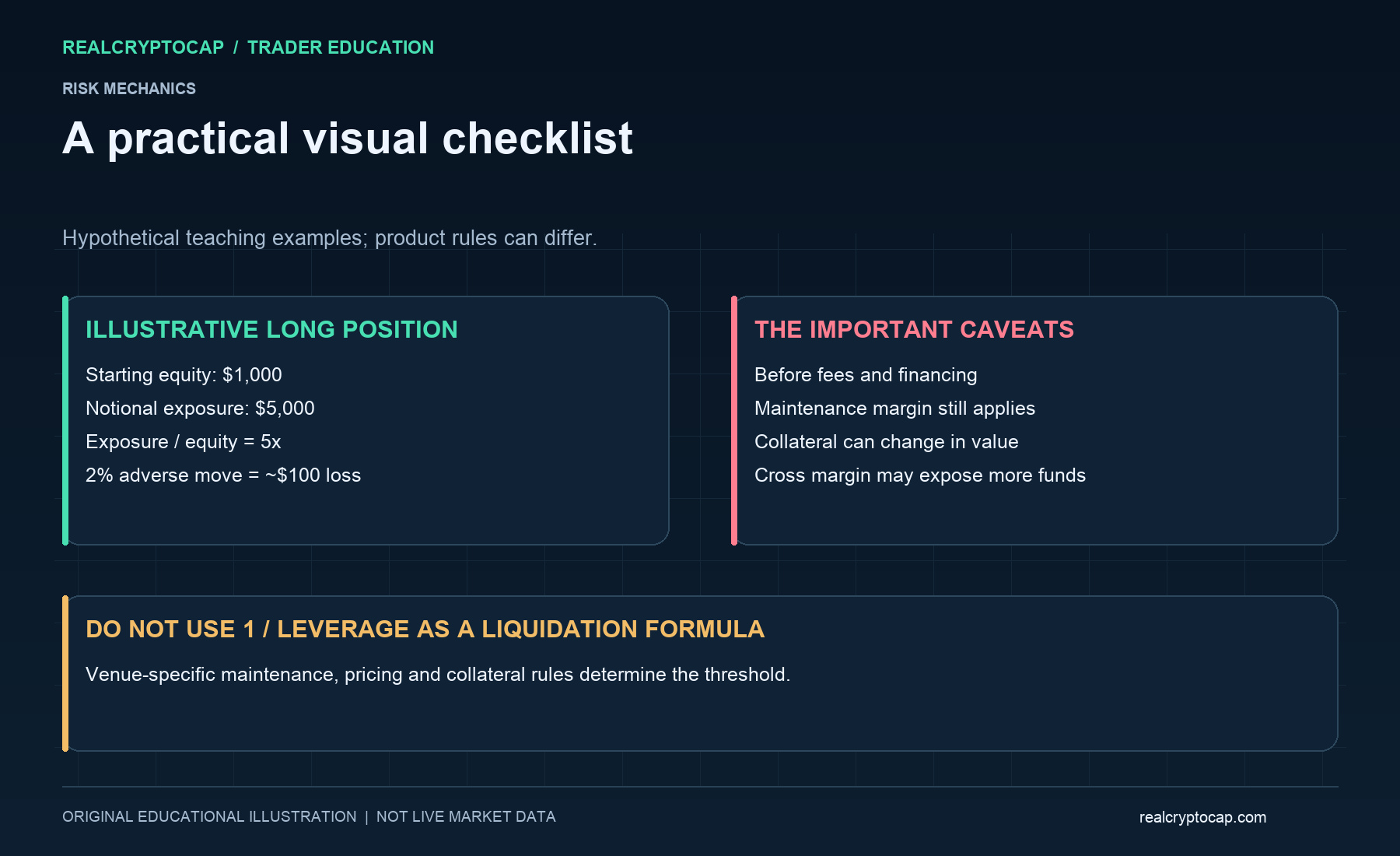
Collateral itself can move. If a volatile token backs a losing position and also falls in price, your cushion may shrink from two directions. Several positions that appear different may be highly correlated during a market shock.
Borrowing costs are not the same as funding
Leveraged spot borrowing can incur opening, financing or rollover charges. Perpetual contracts may exchange funding payments between long and short holders under a separate formula; those payments can change direction and size. There may also be trading, conversion and liquidation fees. Check current product documentation rather than copying a headline rate from a tutorial.
Availability and maximum leverage differ by country, customer eligibility, asset and venue. A product being described online does not mean you are eligible to use it. This guide does not recommend opening a leveraged account.
Size a hypothetical risk before opening
Suppose a learner models a $50 loss budget and a 2% entry-to-stop distance. Dividing $50 by 0.02 gives $2,500 of notional exposure before costs. That is a teaching calculation, not a position recommendation. It assumes an exit near the planned level; gaps, fees and slippage can make the actual loss larger. The venue's minimums, collateral requirements and liquidation mechanics still need checking independently.
Before any real position, understand how the mark or index price is used, when liquidation occurs, which collateral is at risk and how borrowing or funding accrues. A stop order is not a guaranteed exit, and liquidation is not an ordinary risk-management plan.
Practice the failure case
Model a fast adverse move, a widening spread and an unavailable exit—not just a favorable chart. Start with https://realcryptocap.com/articles/crypto-paper-trading-guide and compare unleveraged mechanics in https://realcryptocap.com/articles/crypto-spot-trading-beginners-guide. A leverage slider is a risk multiplier, not a target.
Sources and further reading: Kraken, What is crypto margin trading? — https://www.kraken.com/learn/what-is-crypto-margin-trading; Kraken margin product information — https://www.kraken.com/features/margin-trading. Product terms change; verify them directly. Independent educational synthesis, not investment advice.