Crypto Limit Orders Explained: Price Control Without a Fill Guarantee
A limit order is an instruction to buy at a specified price or lower, or sell at a specified price or higher. It controls the acceptable execution price. It does not guarantee a fill, set your maximum portfolio.
Educational guide. Examples are hypothetical, not live quotes. Not personalized investment advice.
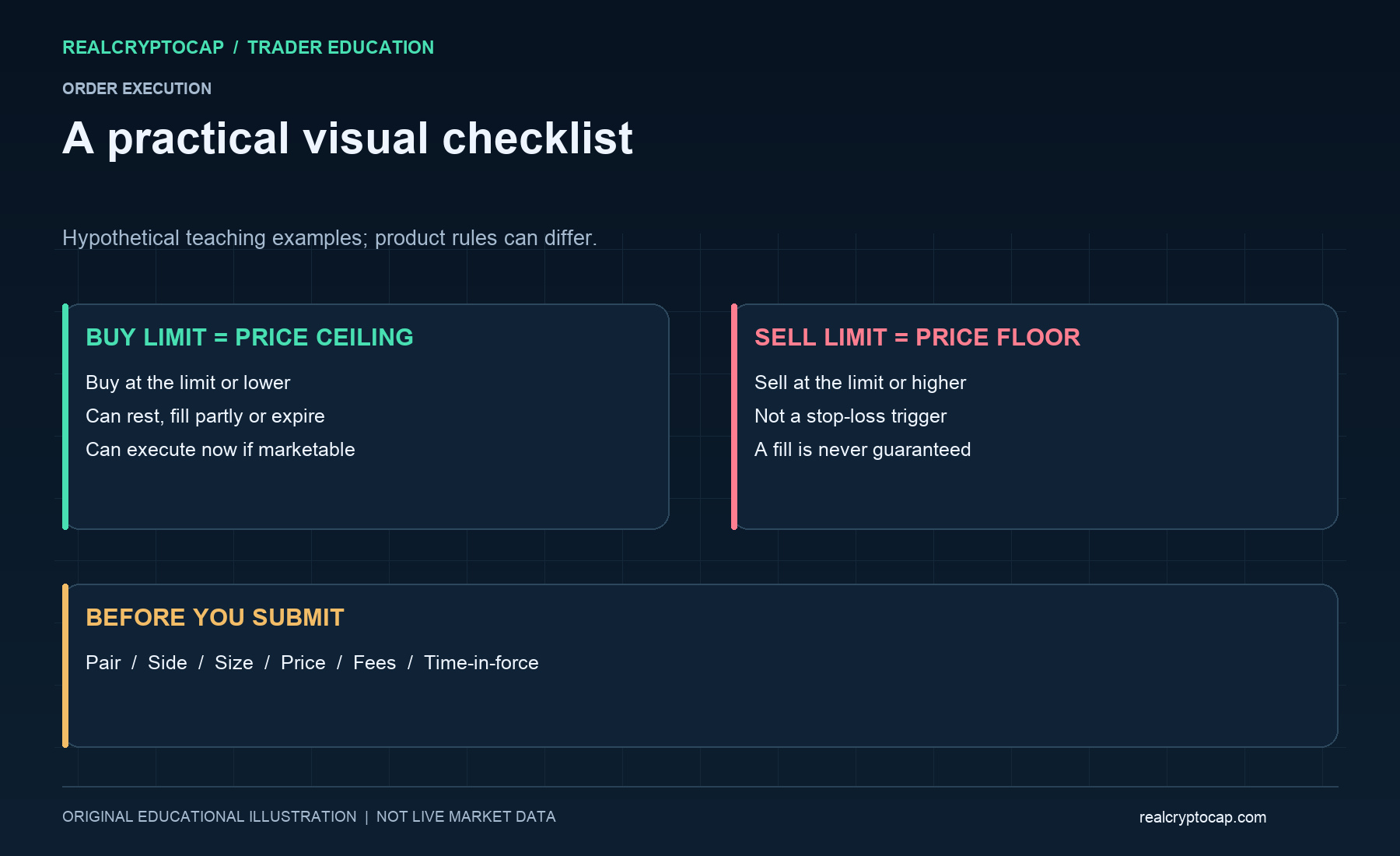
A limit order is an instruction to buy at a specified price or lower, or sell at a specified price or higher. It controls the acceptable execution price. It does not guarantee a fill, set your maximum portfolio loss, or automatically make you a maker instead of a taker.
A buy limit sets a ceiling; a sell limit sets a floor
Suppose BTC is offered near $50,000 and you place a buy limit for 0.01 BTC at $49,500. You are willing to pay no more than $49,500 per BTC, excluding fees. The order may rest until matching sell interest becomes available. If the market rises instead, you may buy nothing.
A sell limit at $51,000 expresses the opposite condition: sell only at $51,000 or better. Neither order is a prediction. Both are conditional instructions operating under your exchange's matching, time-in-force and risk rules.
Limit orders can execute immediately
Imagine the best ask is $50,000 and you enter a buy limit at $50,100. Your order crosses the spread and can immediately match available asks up to $50,100. It is a marketable limit order. It can therefore pay taker fees for the executed portion, depending on the venue's fee schedule.
A post-only instruction is different. Where supported, it typically prevents immediate liquidity-taking by rejecting or cancelling an order that would cross the book; exact behavior varies. Check the order preview rather than assuming the word limit means a cheaper fee.
Partial fills and queue position
If you request 0.02 BTC at $49,500 and only 0.006 BTC matches, you have a partial fill and may still have 0.014 BTC open. The unfilled portion is not a second confirmed purchase. Cancel requests can race against execution; a request to cancel is not proof that nothing traded.
A chart touching your price also does not guarantee your order filled. Other orders may have priority at the same price, the displayed chart may come from another venue, or only a small quantity may have traded there. Matching priority is venue-specific; price-time priority is common but not universal.
Set the order duration
Good-till-cancelled orders generally remain active until filled or cancelled, subject to venue rules. Immediate-or-cancel orders execute what they can immediately and cancel the remainder. Fill-or-kill orders require the entire requested quantity to execute immediately or not at all, where offered. Some platforms also support expiry times. Not every market supports every option.
Before submitting: verify the pair, side, base quantity or quote spend, limit price, available balance, fees and time-in-force. After submitting: verify the order's status in the open-orders panel and check the fills history. Reconcile each partial fill before placing a replacement order.
A limit is not a stop-loss
A regular sell limit below the current best bid can execute immediately; it does not wait for the market to fall. A stop order adds a trigger condition. A stop-market order typically becomes a market order after triggering and can slip. A stop-limit order becomes a limit order after triggering and can remain unfilled if price moves beyond the limit.
For example, a hypothetical stop-limit sell with a $48,000 trigger and a $47,800 limit may fail to sell if the market gaps straight to $47,000. Trigger sources, order availability and protections vary by product. Read the platform's documentation before relying on any protective order.
A practical decision framework
If an exact acceptable price matters more than immediate execution, consider what non-execution would mean before choosing a limit. If immediate execution matters more, understand the spread and slippage risks of a market order. No order type removes market risk. Practice these differences first: https://realcryptocap.com/articles/crypto-paper-trading-guide.
Sources and further reading: Coinbase, Order types — https://www.coinbase.com/learn/advanced-trading/order-types; Coinbase, What is slippage in crypto and how to minimize its impact? — https://www.coinbase.com/learn/crypto-glossary/what-is-slippage-in-crypto-and-how-to-minimize-its-impact. Independent explanation; hypothetical examples.